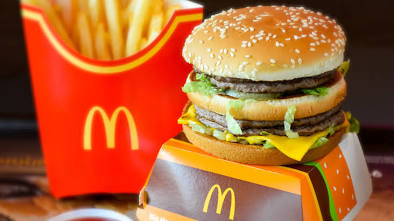
There’s a version of the cost of living debate that involves a lot of economic jargon, index-linked gilts, and charts with multiple axes. And then there’s the Big Mac. I call it the Big Mac Test.
Everyone knows what a Big Mac is. Most people have bought one at some point. And that familiarity makes it one of the most useful tools I know for cutting through the noise and asking a simple question: are everyday prices rising faster than they should be?
I think they are. And the numbers are pretty hard to argue with.
What Did a Big Mac Actually Cost in 1990?
Nailing down an exact price from 1990 is trickier than you’d think. McDonald’s don’t exactly publish a historical price archive, and the internet wasn’t documenting burger prices in any meaningful way back then.
What we do know is that a surviving McDonald’s menu from 1993 shows a Big Mac priced at £1.79. Working backwards from there, and accounting for the fact that prices were rising in the early 90s, a reasonable estimate for a standalone Big Mac in 1990 is around £1.50. It’s not an exact figure, but it’s close enough for what we’re doing here.
So let’s use £1.50 as our baseline.
What Should It Cost Today?
This is where it gets interesting. If the Big Mac had simply risen in line with general UK inflation, measured using the ONS Consumer Price Index, here’s what would have happened.
Between 1990 and 2026, UK prices roughly increased by a factor of 2.5. That means £1 in 1990 buys the same as about £2.50 today in broad terms.
Apply that to our £1.50 Big Mac and you get £3.75.
| Price | |
|---|---|
| Big Mac in 1990 | ~£1.50 |
| What it should cost today (CPI inflation only) | ~£3.75 |
| What it actually costs today | ~£4.99 |
| The overshoot | ~£1.24, around 33% above inflation |
So the Big Mac hasn’t just risen with inflation. It’s risen a third more than inflation over 35 years. That’s the number worth sitting with.
Why Has It Gone Further Than Inflation?
To be fair to McDonald’s, this isn’t simply a case of a company helping itself to extra margin. There are real reasons why fast food has become more expensive than general inflation would suggest.
The biggest one is labour. Minimum wage increases in the UK have been significant in recent years, and for a business that employs tens of thousands of people on or near the minimum wage, that feeds directly into operating costs. When the national living wage goes up, prices tend to follow.
Energy costs have also played a role. Running restaurant kitchens at scale is expensive, and the energy price increases of the past few years hit the hospitality and food service sector particularly hard.
And then there’s the ingredient side. Beef, wheat for buns, cooking oil. All of these have seen global supply chain pressures push prices up beyond what general inflation would capture.
None of this means price rises are unreasonable. But it does mean that fast food, once considered a cheap option almost by definition, has drifted upward in a way that outpaces what a straightforward inflation adjustment would justify.
Worth noting too: this pattern isn’t unique to McDonald’s. If you look at your daily coffee, your subscriptions, your supermarket staples, the same story plays out across the board. Specific categories of spending have risen faster than headline inflation, often in ways that are easy to miss because the changes happen gradually.
The Post-2020 Acceleration
It’s also worth separating the long-term trend from what’s happened more recently, because the last five years have been a different story entirely.
Since 2020, McDonald’s average menu prices have risen by around 40%. To put that in context, UK CPI inflation over the same period was roughly 25%. So while the long-term picture shows a 33% overshoot versus inflation, the recent acceleration has been sharper.
Some of that is post-pandemic catch-up. Some of it is the energy crisis. Some of it is genuine wage cost pressures. But the net effect is that a burger which felt like a small treat ten years ago now costs the same as a sit-down lunch used to.
The Practical Response: Don’t Pay Full Price
None of this means avoiding McDonald’s. That’s your call. But if you’re going to go, paying full menu price is arguably unnecessary.
The McDonald’s app regularly carries deals that bring prices back down meaningfully. Free items, discounted meals, loyalty points that add up over time. People who use the app consistently are saving a reasonable amount each month versus just walking up to the counter and ordering.
It’s a small version of the same principle I apply to everything on this site. The price on the label isn’t necessarily the price you have to pay. A bit of deliberate behaviour, using the app, checking for offers, not just defaulting to the first option, gets you a better outcome without much effort.
If you want to understand how this kind of habit applies to your wider spending, the subscription cost calculator on this site is a good place to start seeing where your money is quietly going. And if you’re interested in how cashback stacking works as a broader strategy, applying it to everything from insurance to gift cards, take a look at my cashback apps guide.
The Big Mac Test: The Bigger Point
The Big Mac is useful precisely because it’s so ordinary. It’s not a luxury. It’s not something anyone would describe as indulgent. It’s just a burger.
And yet something that cost £1.50 in 1990 now costs £4.99. That’s a 233% increase. Inflation over the same period? Around 150%.
The gap between those two numbers is the story of how everyday costs have quietly outrun what most people’s wages and savings have kept pace with. It’s not dramatic. It doesn’t happen overnight. But it accumulates.
Knowing it’s happening is the first step. Adjusting your habits around it, using the app, stacking cashback, making deliberate choices rather than default ones, is where the actual money saving comes in. That’s what this site is about, really. Not cutting everything out. Just making sure every pound is working as hard as it can.
For more on spending habits and understanding where your money actually goes, take a look at my spending habits guide.
Prices quoted are estimates based on publicly available data and ONS CPI figures. The 1990 Big Mac price of ~£1.50 is derived from a known 1993 menu price of £1.79 and adjusted backwards. Current prices based on average UK McDonald’s pricing as of May 2026.